
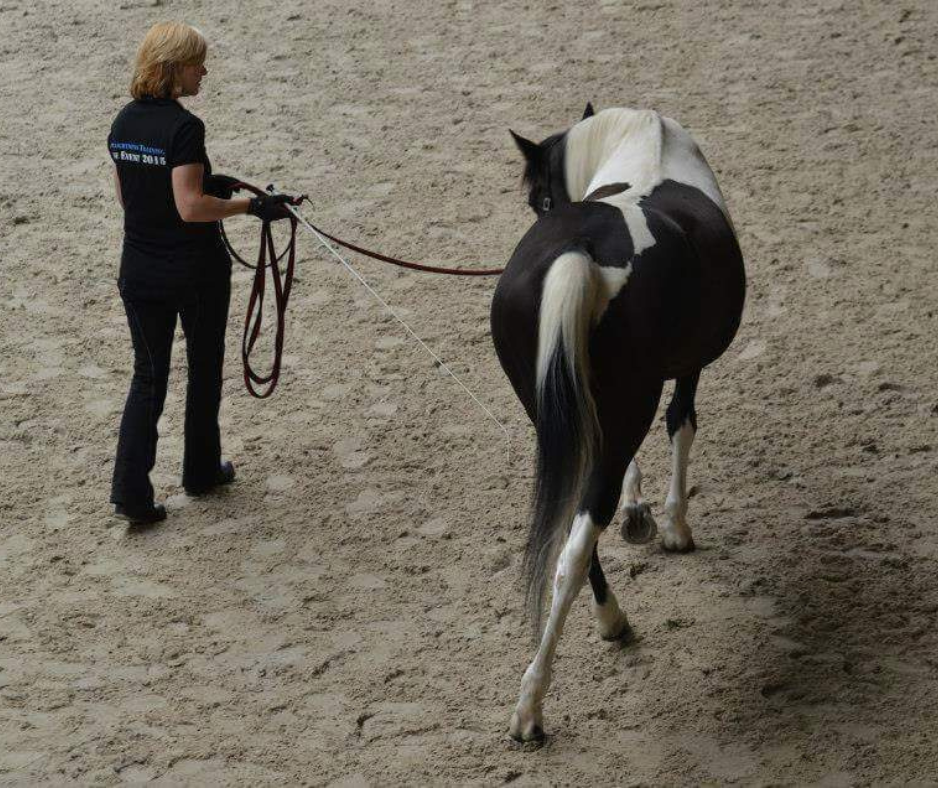
A clearer, kinder, biomechanically sound way to longe your horse without gadgets, while preserving his natural balance and well-being.
Why Longeing Horses Without Gadgets on a Circle Is So Challenging
Before we look closely at longeing horses without gadgets, it helps to realise that travelling on a circle is not biomechanically the same as travelling in a straight line.
On a circle, the horse must cope with outward-directed centrifugal forces created by his own speed and body weight. The faster he moves, the harder it is to stay upright.
Scientific research has shown that horses alter their posture and centre of mass when moving on a circular path. They adapt their bodies to the demands of the turn.
This means the horse must adjust his balance and posture, slightly shift his centre of mass towards the inside, and organise his limbs and body differently, both front and behind, to stay coordinated, comfortable, and upright.
So the circle itself is already part of the training challenge.
Longeing a horse that cannot yet turn on a circle in balance exacerbates the effects of natural asymmetry. The horse may lean in, shorten the muscles of the topline, engage the underneck, and look to the outside. This in turn can contribute to physical discomfort, tension, and emotional stress.
Why Riders Turn to Training Aids
When a horse struggles to balance on the circle, it is understandable that riders look for equipment that appears to offer a solution. Training aids can seem to promise a quicker way to encourage a round outline, build topline, and develop self-carriage.
In practice, true self-carriage means the horse organises and supports his own body with relaxation, lightness, and balance, instead of relying on the rider or equipment to hold him in place.
True self-carriage develops through straightness, balance, suppleness, strength, and coordination. It begins with hind legs that can bend and step under the horse’s rib cage to support the centre of mass.
Simply fixing the horse’s head and neck in a set position cannot create this.
The horse’s head and neck posture tells us what is happening in his body. If all is well in his body, his neck should be long, his under neck muscles loose, and his nose slightly in front of the vertical.
There should be a soft lateral bending through the body, and a forward-down tendency of his head and neck that comes from balanced energy from behind. Over time this posture will help to develop a healthy topline and contribute to the horse’s comfort and wellbeing.
Without the understanding to develop a correct posture in their horses, handlers often reach for training aids. But they only create the appearance of self-carriage without the healthy physical foundation to support it.
An Early Experience of Mine With a Training Aid
“He was trussed up like a turkey!”
That’s the only way I can describe it. Ropes wrapped around his body, his head pulled in from his mouth, eyes wide and tense. And I hadn’t even asked him to move yet!
I’d bought this very expensive training aid, which was really just a rope with pulleys and clips, because I’d been told it would help improve his topline and self-carriage.
But once I’d fitted it, he looked at me, and I saw a deep sadness in his eyes.
I took it off straight away.
At the time, I didn’t know what else to do; I just knew this wasn’t the way.
Years later, having discovered a more balanced, horse-centred way to longe, I still remember that look and the moment I realised this approach was wrong for him.
Why Training Aids Often Create New Problems
Many people use these tools with good intentions, but the signs of discomfort are often missed. Flattened ears, tension in the jaw, and bulging eyes all ask, “why are you doing this to me?”
Even the official promotional images for the training aids show the problems:
- The horse is forced onto the forehand, with weight on the front legs
- The nose is behind the vertical (the only possible outcome with this setup)
- No lateral bend, the horse is not able to turn on the circle
- Constant pressure on the bit, with a tight noseband
- Jerking on the bit from the lines attached behind
- Facial tension, flared nostrils, discomfort, pain
- Excessive mouth foam suggesting the horse cannot swallow properly

Another premium version shows the same issues:
- A desperate expression in the eye
- A tight noseband and false contact created by backward‑pulling pressure
- Draw‑rein‑like action pulling the nose behind the vertical, loading the nuchal ligament and first cervical vertebrae
- Weight shifted onto the forehand, especially the right front leg
- Leaning into the circle; vertical imbalance makes the horse feel unsafe
- Hind legs pushing backwards instead of carrying weight

These images are marketed as “correct”, but they show a horse in discomfort, imbalance, and emotional distress.
Common Myths About Longeing and Gadgets
One of the biggest myths in longeing horses is that they need side reins or gadgets to learn balance. In reality, these tools often create tension, resistance, pain, and confusion.
They may produce a false “round” outline, but they rarely produce true engagement. They also do not help to address the horse’s natural asymmetry.
When the horse searches towards the hand, the rider should yield the hand forwards and allow him to take the rein forward and down. This lets him lengthen his neck and topline muscles.
Side reins cannot teach the horse to search towards the hand because they do not yield.
Without that giving hand, the inevitable consequence is that the nose tips behind the vertical. The horse is then likely to evade the contact or lean on it, and the centre of mass falls onto the forehand, as in the picture.

When a bit with lever action that acts on the poll is used, as in the picture, together with side reins, the horse has no choice but to curl his nose up behind the vertical. This puts pressure on the first three bones of the neck behind the skull and on the nuchal ligament. The horse is again forced onto his forehand so that the majority of his body weight is on the delicate front legs.
The Other Extreme: Longeing With No Support or Guidance
The opposite approach, longeing horses without gadgets but sending them out on a long line with no support or preparation, is equally problematic.
It feels “natural”, but horses don’t move in 20‑metre circles in nature. Most horses must be taught how to turn in balance.
An unbalanced horse:
- cannot bend laterally
- cannot turn on the circle
- pushes the hind legs backwards and out
- hollows the topline
- falls onto the inside shoulder
- feels unsafe and uncoordinated
This exacerbates his natural asymmetry and makes him feel even more out of balance and unsafe.


Comparing Approaches: Training Gadgets, No Guidance, and Balanced Longeing
Neither approach supports the horse’s long-term health.
Neither teaches him how to carry himself or addresses his natural asymmetries.
And neither reflects the kind of relationship most of us want with our horses.
Pressure creates resistance, and this is true of any gadget.
Training aids and side reins create a false appearance of yielding and softness, because the horse is using the wrong muscles to avoid the pain of the pressure.
And he is usually engaging the exact opposite muscles to those we want him to develop!
On the other hand, longeing horses without gadgets, and without teaching them how to move in balance, can leave them flailing. This makes their natural asymmetry worse, reinforces poor movement patterns, and increases the risk of injury.
But there is a “third way” to longe horses without gadgets. It is not only possible for all horses, it is also surprisingly simple to learn.
Once you see your horse move on the longe in true self-carriage, with correct balance, suppleness, and shape, soft and searching towards the hand, you’ll never want to go back.
What Is This “Third Way” of Longeing?
The “third way” to longe horses without gadgets is about teaching the horse to move in a healthy posture and to keep his own self-carriage at a distance from the trainer.

This approach uses clear communication and a gradual educational process to teach the horse how to move in balance. Instead of holding him together with equipment, you guide him towards a way of moving that feels good and supports his physical and emotional well-being.

You can train your horse or pony in all lateral exercises and side movements on the longe, up to high school movements.
How I Teach Longeing horses Without Gadgets
- First, we teach the horse a set of aids to build up clear communication.
- Then, starting close to the horse, we guide him into a proper shape so that he learns a new way of carrying himself.
- When this is going well, we gradually send him out onto a bigger circle, guiding him to maintain balance, suppleness, and shape at a greater distance.

We start in walk because the horse’s muscles need to adapt. He also needs to find a new way of moving, which can feel strange to him at first.
Then we gradually add the trot and canter, and later the lateral movements, but only when the horse is ready.

Why Balanced Longeing Without Gadgets Is Better For Your Horse
Training your horse to longe this ‘third way’ in self-carriage has many benefits:
- Prepares your horse for riding by teaching a clear set of aids and building strength and coordination so that the horse is physically and mentally prepared to carry the weight of the rider.
- Improves balance and straightness – the horse learns to turn on the circle instead of leaning in like a motorbike. This makes him feel safer because he no longer feels like he might fall.
- Addresses natural asymmetry – the horse’s body changes: tight muscles start to relax, and long, weak muscles get stronger. He can then move easily on circles both to the left and right, and the weight is more evenly distributed over all four feet.
- Conditions the topline – the horse learns to relax and lengthen the muscles of the topline.
- Strengthens the abdominal muscles – as the underneck and topline muscles release, the abdominals and thoracic sling muscles can engage through isometric contraction.
- Supports joint health and longevity by shifting the weight from the preferred front leg and encouraging even loading over all four legs.
- Improves coordination and proprioception, especially in young or rehabbing horses that tend to overtrack.
- Builds emotional regulation – emotional balance comes with physical balance. It feels uncomfortable, and often painful, for a horse to move on the longe with the majority of the body weight in the shoulders. When the shoulders are free, the horse feels safer and more comfortable.
- Develops a solid basic foundation.
When a horse learns to carry himself well, he feels better. He moves better. He becomes more confident, more expressive, and more connected.
And you, as the trainer, become more skilled and observant. You develop a far greater understanding of the way your horse moves biomechanically.
Is Balanced Longeing horses Without Gadgets Difficult to Learn?
Not at all, but it can take a little time and effort. It requires observation, patience, and a willingness to let go of quick fixes.
If you are not used to working with your horse from the ground, there may be other challenges to address first.
The main principles are:
- Teach the aids before you use them: Aids are usually taught at a standstill so that the horse can understand them fully and can easily respond in movement.
- Start in Groundwork: It’s a gradual process. Teach the horse to yield to pressure, so that you can influence the shoulders and the hindquarters, and help the horse to find balance, suppleness, and shape in a Groundwork position first.
- Gradually send him out onto a bigger circle: teach him to keep the posture (balance, suppleness, shape, tempo, rhythm, search towards the hand) himself.
- Learn about body language: Where you stand, how you move, your energy, the angle of your shoulders and hips, your speed, your rhythm, and the inner picture and inner feeling you project all matter. Your horse will respond to all of it if you start using it.
The only equipment you need is a cavesson, longe line, and dressage whip or stick.
You just need a willingness to learn and a commitment to your horse’s well-being.
Final Thoughts
This “third way” to longe may take a little time to learn and to teach your horse, but it is deeply rewarding.
It gives you a horse who moves in balance, with suppleness and relaxed self‑carriage, without tie-downs.
Maybe you’ve felt uneasy about side reins…
Or watched your horse rush hollow around the circle…
Or you believe training should improve the horse, not just put him in a shape…
Then this approach may be exactly what you’ve been looking for.
For me, good training is about teaching the horse something that will improve him, in a way that he can truly understand.
It’s never about squeezing the horse into an outline.
Longeing, done well, can be truly beautiful and a lot of fun!
FAQ
Why shouldn’t I use side reins or training gadgets?
Side reins and similar gadgets create a fixed, backward‑pulling pressure. They cannot yield when the horse searches forward and down, so they create resistance and the horse is forced behind the vertical and onto the forehand. This creates tension, discomfort, and false “roundness”, rather than the true balance that can be found when we take the time to learn about balanced longeing without gadgets.
Isn’t longeing without gadgets too loose or uncontrolled?
Longeing is not harmful when the horse is taught how to move in a healthy way. Without guidance, an unbalanced horse will fall in, fall out, hollow, or rush. But when you teach the basic aids first and create correct lateral bending, forward‑down, and stepping under of the inside hind leg, the horse can move on the circle in genuine self‑carriage.
Do I need a special cavesson?
You can get started with a halter, but a well‑fitting cavesson is ideal because it allows clear communication without pulling on the mouth. It keeps the horse comfortable and helps you influence the position of the head and neck. You can then give subtle communication and half halts to help shape balance without needing a bit. Contact Wendy for advice on the recommended cavesson.
Can any horse learn to longe in balance?
Yes. Young horses, older horses, companions, rehab horses, and horses and ponies of all breeds, sizes, and ages can learn this way. The process is calm, progressive, and tailored to the horse’s natural ability. Some horses take longer, but all benefit.
Is this method suitable for beginners?
Absolutely. The Balance First process for longeing horses without gadgets is designed to be clear and step‑by‑step. You teach the aids at a standstill first so both you and your horse understand the conversation before moving onto the circle.
How long does it take to see improvement?
Most horses show changes in posture and relaxation, become more supple in their bodies, and are able to bend more equally both left and right within a few sessions. Balance, straightness, and topline develop gradually as the horse learns to carry himself.
What if my horse leans, rushes, or falls in?
These are symptoms of natural asymmetry or confusion and are a sign that you have skipped a step and moved on too soon. You simply return to the previous step and make sure that the three main essences are in place: lateral bending, forward‑down, stepping under of the inside hind leg.
Is this the same as classical longeing?
It shares the same principles of balance, bend, and self‑carriage, but it is taught in a clearer, more accessible way for modern riders. No force, no gadgets, no fixed frames, just clear communication and healthy biomechanics.
Can this replace riding?
It is perfect and hugely beneficial for horses that cannot, or don’t want to, be ridden, but it also complements riding beautifully. The aids and exercises for longeing horses without gedgets are taught from the ground and are designed to transfer directly to riding. Many riders find their horses become calmer, straighter, and easier to ride after groundwork.
Where can I learn the step‑by‑step method?
You can explore the Balance First groundwork & longeing approach through my beginner resources, lessons, and membership – all designed to help you teach your own horse self-carriage without force or gadgets.
Inside the Balance First membership you will find more details on this and other related topics. Click the button below to find out more.
References and Further Reading
Clayton HM, Sha D. Head and body centre of mass movement in horses trotting on a circular path. Equine Veterinary Journal. 2006.